
May 2026 AI Reliability Report
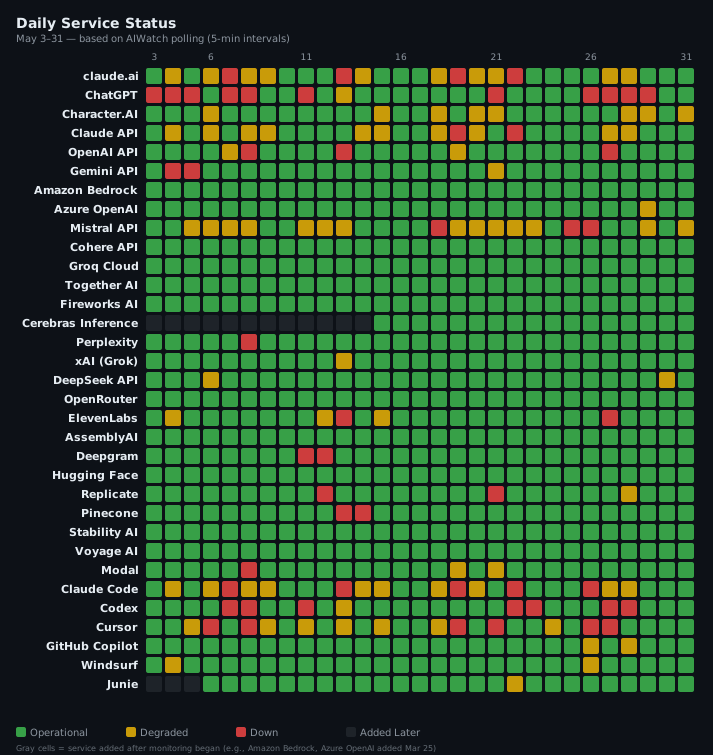
Source: ai-watch.dev — Real-time AI service status monitoring Period: May 1–31, 2026 Published: June 2026 Services monitored: 33 — 24 API services, 6 coding agents, 3 AI apps
Summary
- Most reliable: Modal (97/100, Excellent) — the top score of all 33 services, with 99.40% uptime; serverless GPU compute that held steady all month.
- Riskiest this month: Replicate (61/100, Fair) — the lowest score, with a 3h 43m average recovery across 4 incidents.
- High incident count, fast recovery: Mistral API (155 incidents, 19m avg resolution — up again from April’s 97, a new high) and Together AI (133 incidents, 43m avg — roughly flat vs April’s 139). The high counts come from per-component reporting plus the micro-incidents surfaced since a probe-filter retune, not from instability (both still scored Good, 78 / 84).
- Watch out: Gemini API (only 2 incidents but a 22h 32m average recovery, 45h 4m total downtime) and the Anthropic stack — Claude API / claude.ai / Claude Code all landed Fair (63–65). ChatGPT had the consumer tier’s heaviest disruption — 11 incidents, 50h 55m total, longest 15h 16m, 4h 38m average recovery.
Summary in Korean
- 가장 안정적: Modal (97/100, Excellent) — 가동률 99.40%로 전체 1위. 한 달 내내 안정적으로 운영된 서버리스 GPU 컴퓨트입니다.
- 이번 달 가장 위험: Replicate (61/100, Fair) — 전체 최저 점수. 장애 4건에 평균 복구 시간이 3h 43m으로 길었습니다.
- 잦은 장애, 빠른 복구: Mistral API (155건, 평균 복구 19m — 4월 97건에서 다시 늘어 최고치), Together AI (133건, 평균 43m — 4월 139건과 비슷한 수준). 건수가 많은 것은 컴포넌트별 집계와 probe 필터 재조정 이후 미세 장애가 잡히기 때문이지 서비스가 불안정해서가 아닙니다 (둘 다 Good, 78 / 84).
- 주의 필요: Gemini API (장애는 2건뿐이지만 평균 복구 22h 32m, 총 다운타임 45h 4m)와 Anthropic 제품군 — Claude API·claude.ai·Claude Code가 모두 Fair (63–65)에 머물렀습니다. ChatGPT는 소비자용 앱 중 장애가 가장 잦고 길었습니다 — 11건, 총 50h 55m, 최장 15h 16m, 평균 복구 4h 38m.
Recommendations
| Use Case | Recommended | Why |
|---|---|---|
| Production-critical | Groq Cloud / Cohere API | Zero incidents and 100.00% uptime all month (91 / 89) |
| Low latency / cost | Groq Cloud / Fireworks AI | Fast p75 RTT (208 / 216 ms) with zero or 5m-recovery incidents; Gemini is fastest at 63 ms but carries a 22h+ recovery risk |
| Coding Agents | Junie / GitHub Copilot | Most stable agents — 93 / 92, only 2h 1m / 9h 5m total downtime, 30m / 1h 31m avg recovery |
| Voice / audio | AssemblyAI | Best voice score (75, 100.00% uptime); Deepgram lagged (64, 1999 ms p75, 6h 4m recovery) |
| General purpose | OpenAI API | Most reliable of the major general LLMs (80, Good) — 7 incidents, 1h 36m avg recovery, fast 205 ms p75 |
Key Insight
Reading beyond the Summary’s service-by-service view, three patterns shaped May — how to read incident counts, why recovery speed mattered more than count, and a standout turnaround in the coding-agent tier. Across the board, 26 of 33 services recorded at least one incident, for a combined 611h 4m of downtime.
- Pattern 1 — Incident count is the most misread metric: the two highest counts of any service (Mistral 155, Together AI 133) belong to two of the faster-recovering, Good-tier services. Because providers report at different granularities (per-component vs service-level), raw counts are not comparable across vendors — adjust for that before ranking. The same caveat held in March and April; it is structural, not a one-month artifact.
- Pattern 2 — A few long outages hurt more than many short ones: Gemini API had just 2 incidents but averaged 22h 32m to recover (45h 4m total), dropping it to Fair (64). Codex (7h 48m avg) and Deepgram (6h 4m avg) show the same long-tail-recovery drag, while Fireworks AI (5m) shows the upside.
- Pattern 3 — Coding agents were the most stable tier, led by a standout turnaround: Junie (93), GitHub Copilot (92), and Windsurf (92) all scored Excellent. Copilot is the month’s biggest reversal — it sat at the bottom of the tier in both March (18 affected days) and April (69, 84h 32m total downtime), but May brought just 6 incidents and 9h 5m total. By contrast the consumer-facing apps were choppy — ChatGPT had the tier’s heaviest disruption (11 incidents, longest 15h 16m, 4h 38m avg recovery) and Character.AI logged 29 incidents (though it recovered in ~20m).
Key Insight in Korean
Summary가 서비스를 하나하나 짚었다면, 여기서는 5월 전반을 관통한 세 가지 흐름을 봅니다 — 장애 건수를 어떻게 읽어야 하는지, 건수보다 복구 속도가 왜 더 중요했는지, 그리고 코딩 에이전트에서 나온 뚜렷한 반전입니다. 5월에는 33개 중 26개 서비스가 한 건 이상의 장애를 겪었고, 총 다운타임은 611h 4m였습니다.
- 패턴 1 — 장애 건수는 가장 오해하기 쉬운 지표: 전체에서 건수가 가장 많은 Mistral(155)·Together AI(133)가 오히려 복구가 빠른 Good 등급입니다. 제공사마다 집계 단위(컴포넌트별 vs 서비스별)가 달라 단순 건수로는 제공사끼리 비교할 수 없으니, 순위를 매기기 전에 이를 감안해야 합니다. 이 점은 3월·4월에도 똑같았습니다 — 한 달만의 현상이 아니라 구조적인 문제입니다.
- 패턴 2 — 오래 지속되는 장애 하나가 짧은 장애 여러 건보다 더 치명적이다: Gemini API는 장애가 2건뿐이었는데도 평균 복구 시간이 22h 32m(총 45h 4m)이나 걸려 Fair(64)로 내려앉았습니다. Codex(평균 7h 48m)·Deepgram(6h 4m)도 복구가 오래 걸린 반면, Fireworks AI(5m)은 빠른 복구가 얼마나 유리한지 보여줬습니다.
- 패턴 3 — 코딩 에이전트가 가장 안정적이었고, 그 중심엔 뚜렷한 반전이 있었다: Junie(93)·GitHub Copilot(92)·Windsurf(92)가 모두 Excellent를 받았습니다. 그중에서도 Copilot의 반전이 가장 두드러집니다 — 3월(18일간 장애 영향)과 4월(69점, 다운타임 84h 32m)까지 코딩 에이전트 중 최하위였는데, 5월에는 장애 6건·총 9h 5m에 그쳤습니다. 반면 소비자용 앱은 기복이 컸습니다 — ChatGPT는 그중 장애가 가장 잦고 길었고(11건·최장 15h 16m·평균 복구 4h 38m), Character.AI는 29건(평균 복구 ~20m)을 기록했습니다.
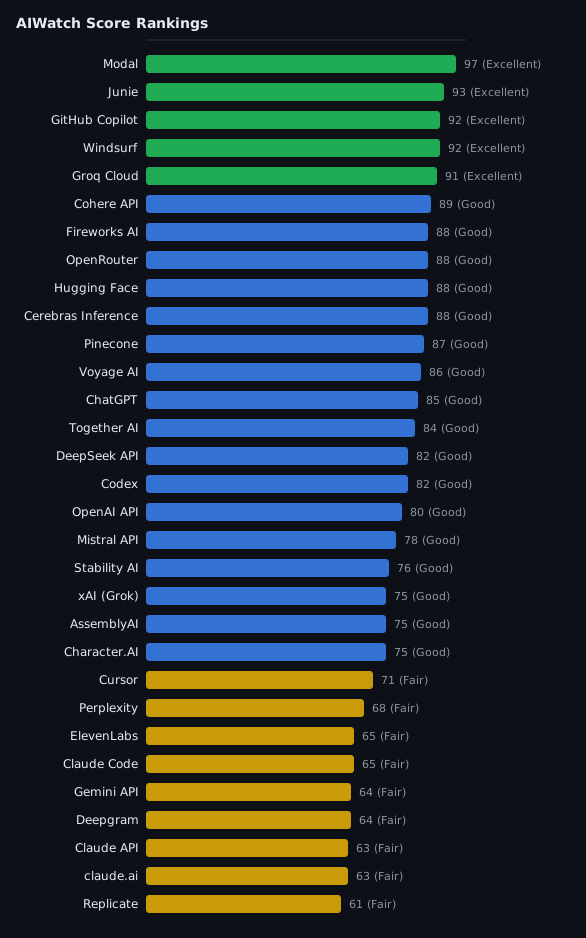
AIWatch Score — May 2026 Reliability Rankings
AIWatch Score (0–100) is designed to answer one question:
“Which AI service is safest to rely on in production?”
Combines four components — Uptime (40%), Incident affected days (25%), Recovery speed (15%), Responsiveness (20%, derived from p75 probe RTT). The per-service p75 RTT figures feeding Responsiveness are listed in the API Response Time — Monthly p75 section below; full breakdown of weights, fallbacks, and penalties is in About This Report. How it’s calculated →
31 of 33 services ranked. Amazon Bedrock and Azure OpenAI are excluded from this ranking — neither publishes an accessible uptime metric, so their Score would inherit an industry-average assumption rather than a measured value, and AIWatch has no reliable incident feed for them (see “No incident feed” under Incident Summary).
| Rank | Service | Score | Grade | Uptime Source | Why |
|---|---|---|---|---|---|
| 1 | Modal | 97 | Excellent | Official | 5 incidents, avg 1h 5m |
| 2 | Junie | 93 | Excellent | Official | 4 incidents, avg 30m |
| 3= | GitHub Copilot | 92 | Excellent | Official | 6 incidents, avg 1h 31m |
| 3= | Windsurf | 92 | Excellent | Official | 5 incidents, avg 57m |
| 5 | Groq Cloud | 91 | Excellent | Official | Zero incidents, 100.00% uptime |
| 6 | Cohere API | 89 | Good | Official | Zero incidents, 100.00% uptime |
| 7= | Fireworks AI | 88 | Good | Official | 3 incidents, fast recovery (avg 5m) |
| 7= | OpenRouter | 88 | Good | Official | Zero incidents, 100.00% uptime |
| 7= | Hugging Face | 88 | Good | Official | 1 incident, 10m |
| 7= | Cerebras Inference | 88 | Good | Official | 1 incident, 58m |
| 11 | Pinecone | 87 | Good | Official | 4 incidents, avg 47m |
| 12 | Voyage AI | 86 | Good | Official | Zero incidents, 100.00% uptime |
| 13 | ChatGPT | 85 | Good | Estimate | 11 incidents, avg 4h 38m |
| 14 | Together AI | 84 | Good | Official | 133 incidents, avg 43m |
| 15= | DeepSeek API | 82 | Good | Official | 3 incidents through ~May 8 — partial month, see DeepSeek correction note below |
| 15= | Codex | 82 | Good | Official | 7 incidents, avg 7h 48m |
| 17 | OpenAI API | 80 | Good | Official | 7 incidents, avg 1h 36m |
| 18 | Mistral API | 78 | Good | Estimate | 155 incidents, fast recovery (avg 19m) |
| 19 | Stability AI | 76 | Good | Official | Zero incidents, 100.00% uptime |
| 20= | xAI (Grok) | 75 | Good | Estimate | 2 incidents, fast recovery (avg 24m) |
| 20= | AssemblyAI | 75 | Good | Official | 3 incidents, avg 2h 55m |
| 20= | Character.AI | 75 | Good | Official | 29 incidents, fast recovery (avg 20m) |
| 23 | Cursor | 71 | Fair | Official | 25 incidents, avg 1h 29m |
| 24 | Perplexity | 68 | Fair | Estimate | 1 incident, 4h |
| 25= | ElevenLabs | 65 | Fair | Official | 9 incidents, avg 1h 32m |
| 25= | Claude Code | 65 | Fair | Official | 35 incidents, avg 1h 36m |
| 27= | Gemini API | 64 | Fair | Estimate | 2 incidents, avg 22h 32m |
| 27= | Deepgram | 64 | Fair | Estimate | 5 incidents, avg 6h 4m |
| 29= | Claude API | 63 | Fair | Official | 34 incidents, avg 1h 30m |
| 29= | claude.ai | 63 | Fair | Official | 34 incidents, avg 1h 32m |
| 31 | Replicate | 61 | Fair | Official | 4 incidents, avg 3h 43m |
Grade scale: Excellent (90+) · Good (75+) · Fair (55+) · Degrading (40+) · Unstable (<40)
Uptime Source column: Official (read directly from the service’s status page) · Estimate (no official metric; only the Score input is computed — the % itself is not surfaced) · Partial (Nd) (service newly tracked mid-month). Full definitions: About This Report → Uptime Source.
Official Uptime (Primary Component)
Reference table. Official 30-day uptime metrics from each service’s status page (where published). The narrative-driven sections below (Incident Summary / Notable Incidents / Observations) cover what these numbers mean for vendor selection.
Amazon Bedrock, Azure OpenAI, Deepgram, Gemini, Mistral, Perplexity, and xAI do not publish a rolling-30-day uptime percentage on their status pages — they’re excluded from this table for that reason. ChatGPT is also excluded — AIWatch’s own month-measured availability for it (its multi-component status is marked degraded whenever any sub-component has an incident) runs far below the rolling-30-day figure OpenAI’s status page publishes (~99.83% on the live status page as of this writing — a current rolling value, not a May measurement), and that status-page month-end value wasn’t captured for May, so no comparable number is shown here. Reports from June 2026 onward surface the status-page figure directly. (xAI’s status page does expose per-endpoint live success rates measured since their monitoring system’s last restart, but those numbers are not directly comparable to the 30-day figures shown above.)
| Service | Uptime |
|---|---|
| Cohere API | 100.00% |
| Groq Cloud | 100.00% |
| Fireworks AI | 100.00% |
| OpenRouter | 100.00% |
| AssemblyAI | 100.00% |
| Hugging Face | 100.00% |
| Stability AI | 100.00% |
| Voyage AI | 100.00% |
| Cerebras Inference | 100.00% |
| Together AI | 99.99% |
| DeepSeek API | 99.92% |
| Junie | 99.84% |
| GitHub Copilot | 99.83% |
| Windsurf | 99.45% |
| Modal | 99.40% |
| Character.AI | 98.71% |
| OpenAI API | 97.76% |
| Replicate | 97.48% |
| ElevenLabs | 97.21% |
| Pinecone | 96.96% |
| Claude API | 96.36% |
| claude.ai | 94.61% |
| Claude Code | 93.85% |
| Cursor | 93.46% |
| Codex | 90.14% |
API Response Time — Monthly p75
These p75 figures are the input to the Responsiveness component (20% weight) of AIWatch Score. Lower is better. The two tables answer different questions: Score Rankings sorts by which service is safest to rely on (combining uptime, incidents, recovery, and responsiveness); this table sorts by which service is fastest at the network layer.
| Rank | Service | p75 (ms) |
|---|---|---|
| 1 | Gemini API | 63 |
| 2 | Claude API | 158 |
| 3 | Mistral API | 196 |
| 4 | OpenAI API | 205 |
| 5 | Groq Cloud | 208 |
| 6 | Cohere API | 215 |
| 7 | Fireworks AI | 216 |
| 8 | Together AI | 282 |
| 9 | Hugging Face | 372 |
| 10 | Cerebras Inference | 389 |
| 11 | Perplexity | 429 |
| 12 | Replicate | 443 |
| 13 | OpenRouter | 482 |
| 14 | xAI (Grok) | 489 |
| 15 | ElevenLabs | 498 |
| 16 | DeepSeek API | 576 |
| 17 | Voyage AI | 697 |
| 18 | Stability AI | 711 |
| 19 | AssemblyAI | 844 |
| 20 | Deepgram | 1999 |
Note: Probe RTT measures direct API endpoint response time from Cloudflare Workers edge (5-min intervals). Values reflect network round-trip time, not inference latency. Services without probe coverage (Bedrock, Azure OpenAI, Pinecone) are excluded from rankings.
Incident Summary
Reading the count column: Incident counts reflect all affected components per service, so providers that report per-model (e.g., Anthropic counts Opus / Sonnet / Haiku separately) show inflated totals vs. providers that report at the service level. Higher count ≠ lower reliability — adjust for granularity before comparing across providers. Full provider-by-provider rules: About This Report → Incident Counting.
| Service | Inc | Downtime (longest) |
|---|---|---|
| Mistral API | 155 | 48h 58m (23h 52m) |
| Together AI | 133 | 94h 55m (6h 20m) |
| Claude Code | 35 | 56h 7m (18h 4m) |
| Claude API | 34 | 51h (18h 4m) |
| claude.ai | 34 | 52h 11m (18h 4m) |
| Character.AI | 29 | 9h 40m (1h 55m) |
| Cursor | 25 | 37h 11m (4h 34m) |
| ChatGPT | 11 | 50h 55m (15h 16m) |
| ElevenLabs | 9 | 13h 49m (5h 1m) |
| OpenAI API | 7 | 11h 9m (2h 56m) |
| Codex | 7 | 54h 37m (18h 21m) |
| GitHub Copilot | 6 | 9h 5m (3h 49m) |
| Deepgram | 5 | 30h 20m (24h 20m) |
| Modal | 5 | 5h 25m (2h 28m) |
| Windsurf | 5 | 4h 47m (1h 38m) |
| Replicate | 4 | 14h 53m (6h 57m) |
| Pinecone | 4 | 3h 9m (1h 19m) |
| Junie | 4 | 2h 1m (45m) |
| Fireworks AI | 3 | 15m (9m) |
| DeepSeek API | 3 | 53m (34m) |
| AssemblyAI | 3 | 8h 44m (4h 21m) |
| Gemini API | 2 | 45h 4m (43h 14m) |
| xAI (Grok) | 2 | 48m (47m) |
| Perplexity | 1 | 4h (4h) |
| Hugging Face | 1 | 10m (10m) |
| Cerebras Inference | 1 | 58m (58m) |
Zero incidents (5 services): Cohere API, Groq Cloud, OpenRouter, Stability AI, Voyage AI — confirmed via their status-page incident feeds.
No incident feed (2 services): Amazon Bedrock, Azure OpenAI — AIWatch has no reliable incident feed for these (RSS / estimate-only), so a blank incident count reflects monitoring coverage, not verified incident-free operation.
Correction — DeepSeek now fully recoverable (June 2026 update): When this report was published, DeepSeek’s status page had migrated from Atlassian Statuspage to Flashduty mid-month and Flashduty blocked AIWatch’s server-side fetches, freezing the feed at 2026-05-08. So the figures in the tables above — 3 incidents, 99.92% uptime, Score 82 — reflect only ~May 1–8. AIWatch can now read the full Flashduty feed via a browser-rendered fetch, so the complete month is recoverable:
- DeepSeek API — 7 incidents (May 6, 6, 8, 21, 24, 28, 28): total 2h 8m, longest 33m, median recovery 18m, ≈99.78% uptime (Atlassian-weighted). The four later incidents (5/21, 5/24, 5/28×2) the frozen feed missed are all short API degradations.
- DeepSeek’s consumer Web Chat surface — now tracked separately as DeepSeek App (from June 2026) — saw 6 incidents over the same period (median recovery 19m).
The ranking, uptime, and incident tables above were not retroactively regenerated (the monthly archive’s daily counters are immutable once written), so they remain the captured-window snapshot; treat these corrected figures as the verified month. DeepSeek returns to a fully-monitored month from June 2026 onward.
Notable Incidents
1. Streaming disruption in Deep Research
Affected: Gemini API Duration: 43h 14m
The single longest incident of the month. Gemini API’s Deep Research streaming responses failed or stalled for nearly two days, while standard non-streaming calls were less affected. With only two incidents all month, this one event is what pushed Gemini’s average recovery to 22h 32m and its score down to Fair (64).
2. Voice Agent degraded by an upstream model-provider dependency
Affected: Deepgram Duration: 24h 20m
For the third month running, Deepgram’s longest incident traced to its Voice Agent’s dependency on an upstream third-party LLM provider (reported on the status page as an OpenAI GPT-4o dependency) — the same pattern documented in March (74h) and April (74h 20m). Real-time agent sessions saw elevated errors while core speech-to-text / text-to-speech stayed available; only the Voice Agent surface degraded. One bright spot: at 24h 20m this was roughly a third of the prior two months’ worst case, though it still drove Deepgram’s 6h 4m average recovery.
3. document_library connector degraded · Integrations API
Affected: Mistral API Duration: 23h 52m
The document_library connector in Mistral’s Integrations API ran degraded for nearly a full day. Mistral logged by far the most incidents this month (155), but they were overwhelmingly brief blips (19m average) — this connector degradation was the notable exception, the longest single Mistral event and the bulk of its 48h 58m monthly downtime.
4. Sustained rate limiting from a usage surge
Affected: Codex Duration: 18h 21m
A surge in demand pushed a growing share of Codex users into rate limits across an 18-hour window. Requests were throttled rather than hard-down, but the prolonged ceiling — together with the shared transcription incident below — drove up Codex’s average recovery to a high 7h 48m.
5. Connection failures for IP-restricted GitHub access
Affected: Claude API (also Claude Code, claude.ai) Duration: 18h 4m
Organizations that restrict GitHub access by IP address hit connection failures against the Claude API for about 18 hours. The same underlying incident surfaced across Anthropic’s stack — Claude Code and claude.ai each recorded the identical 18h 4m peak — a clear illustration of how Anthropic’s per-component reporting turns one root event into several separately-counted incidents.
6. Elevated transcription failures
Affected: ChatGPT & Codex Duration: 15h 16m
Transcription failures rose across both ChatGPT and Codex for over 15 hours. As a shared OpenAI dependency, the single fault surfaced on two products at once — the same shared-infrastructure coupling seen in the Claude entry above. At 15h 16m it was also ChatGPT’s single longest incident of the month.
Observations
Actionable takeaways per service. Descriptive context for each event lives in earlier sections — Summary, Incident Summary, and Notable Incidents. This section is what to do with that data — keep each bullet prescriptive, not a recap.
- If you depend on Gemini for Deep Research or long-running streaming: build in retries and a non-streaming fallback path. Gemini’s incidents were rare but punishingly long (22h 32m avg) — design for graceful degradation, not fast recovery.
- If you run voice/audio workloads: the AssemblyAI-over-Deepgram call (75 / 100% uptime vs 64) now holds three months running. The multi-LLM-failover mitigation for Deepgram’s Voice Agent still stands from prior reports — the narrower new takeaway is to isolate Voice Agent from your core STT/TTS so an upstream-LLM incident can’t take down basic transcription.
- If you build on the Anthropic stack: Claude API, Claude Code, and claude.ai are tied to the same Anthropic infrastructure, so they go down together — a single root incident took all three out at once (18h 4m each). You can’t fail over from one Anthropic surface to another, so for real redundancy pair Anthropic with a non-Anthropic provider.
- Quietly reliable picks within their own role: Fireworks AI (LLM inference — 3 incidents, 5m avg recovery), Junie (coding agent — 4 incidents, 30m avg), and Pinecone (vector DB — 4 incidents, 47m avg) each absorbed real traffic and recovered fast. These are different categories, not interchangeable fallbacks.
- For mission-critical automation: Modal (97) and GitHub Copilot (92) held Excellent scores all month — safe defaults where stability outweighs cost.
Observations in Korean
- Gemini로 Deep Research나 장시간 스트리밍을 쓴다면: 재시도와 비스트리밍 대체 경로를 함께 두세요. Gemini 장애는 드물지만 한 번 나면 오래 지속됩니다(평균 22h 32m) — 복구를 기다리기보다, Gemini가 멈춰도 서비스가 대체 경로로 계속 돌아가도록 설계하는 편이 안전합니다.
- 음성/오디오 작업이라면: AssemblyAI를 Deepgram보다 우선하라는 판단(75·가동률 100% vs 64)은 이제 3개월째 그대로입니다. Deepgram Voice Agent에 LLM을 여러 개 두어 장애에 대비하라는 권고는 앞선 리포트에서 이미 다뤘고, 이번에 새로 강조할 점은 외부 LLM 장애가 기본 STT/TTS까지 끌어내리지 않도록 Voice Agent를 따로 떼어 두라는 것입니다.
- Anthropic 스택을 기반으로 개발한다면: Claude API·Claude Code·claude.ai는 Anthropic의 같은 인프라에 묶여 있어 장애도 함께 겪습니다 — 하나의 근본 장애가 세 서비스를 한꺼번에 멈췄습니다(각 18h 4m). 한쪽이 멈췄을 때 다른 Anthropic 서비스로 우회할 수 없으니, 이중화가 필요하면 Anthropic 외의 제공사를 함께 두세요.
- 각자 영역에서 묵묵히 안정적이었던 선택지: Fireworks AI(LLM 추론 — 3건, 평균 5m), Junie(코딩 에이전트 — 4건, 평균 30m), Pinecone(벡터 DB — 4건, 평균 47m)는 실제 트래픽을 받으면서도 빠르게 복구했습니다. 다만 서로 범주가 달라 그대로 맞바꿔 쓸 수는 없습니다.
- 장애가 치명적인 자동화라면: Modal(97)·GitHub Copilot(92)은 한 달 내내 Excellent를 지켰습니다 — 비용보다 안정성이 우선인 작업의 기본 선택지로 삼기 좋습니다.
Security Alerts
Note: Security alerts captured during the month from OSV.dev (AI SDK package vulnerabilities) and Hacker News (security posts mentioning monitored services). Section omitted for months without detections.
Total alerts: 18
By source
| Source | Count |
|---|---|
| OSV.dev | 18 |
By severity
| Critical | High | Medium | Low |
|---|---|---|---|
| 1 | 3 | 13 | 1 |
Most affected services
| Service | Count |
|---|---|
| Hugging Face | 8 |
| LangChain | 5 |
| Anthropic (Claude) | 3 |
| Mistral | 2 |
Top Findings
1. Malicious dropper in mistralai 2.4.6 PyPI package · critical
- Source: OSV.dev
- Affected: Mistral
- Detected: 2026-05-18
- Fix Version: — (supply-chain: the malicious 2.4.6 release — pin to a known-good version and audit installs)
2. LangSmith SDK: public prompt pull deserializes untrusted manifests without a trust-boundary warning · high
- Source: OSV.dev
- Affected: LangChain
- Detected: 2026-05-13
- Fix Version: 0.8.0
3. LangChain: unsafe deserialization of attacker-controlled objects via overly broad load() allowlists · high
- Source: OSV.dev
- Affected: LangChain
- Detected: 2026-05-09
- Fix Version: 1.3.3
4. LangChain Core: path traversal in legacy load_prompt functions · high
- Source: OSV.dev
- Affected: LangChain
- Detected: 2026-05-08
- Fix Version: 1.2.22
5. Hugging Face transformers — five deserialization / code-execution advisories · medium
- Source: OSV.dev (Zero Day Initiative — ZDI-25-1144, -1150, -1149, -1141, -1147)
- Affected: Hugging Face
- Detected: 2026-05-20
- Fix Version: — (PYSEC-2025-211/212/213/214/217; upgrade
transformersto the latest patched release)
6. langchain-community: unsafe pickle deserialization (PYSEC-2024-278) · medium
- Source: OSV.dev
- Affected: LangChain
- Detected: 2026-05-20
- Fix Version: —
About This Report
- Data Sources: Real-time data is aggregated from official status pages via multiple frameworks, including Atlassian Statuspage, incident.io, Google Cloud Status, Better Stack, Instatus, OnlineOrNot, and RSS feeds (Source: ai-watch.dev).
- Monitoring Frequency: All 33 services are polled every 5 minutes via Cloudflare Workers. Health check probes measure direct API response times (RTT) at the same interval.
- AIWatch Score (0–100): Calculated from four components — Uptime (40%), Incident affected days (25%), Recovery speed (15%), and Responsiveness (20%). Services without probe data use 80→100 score redistribution plus a 5% penalty to reflect the missing responsiveness signal. Full methodology: ai-watch.dev/#about-score
- Uptime Source: Official = service publishes a rolling 30-day uptime metric AIWatch reads directly. Estimate = no official metric; AIWatch substitutes an industry-average assumption (99.5%) or its own poll-derived figure for the Score’s Uptime input. Partial (Nd) = an official source exists but AIWatch’s measurement window is shorter than the full month (e.g. service newly tracked mid-month). The label only describes the Uptime input quality — the Score itself is computed identically across all services.
- Incident Counting: Incident counts reflect all affected components per service. Providers differ in reporting granularity — Anthropic reports per-model incidents (Opus/Sonnet/Haiku each counted separately), while others report at the service level.
- Uptime Metrics: Uptime percentages reflect official single-component figures provided by the status pages. Services marked with “—” do not provide a publicly accessible uptime metric.
- Timezone Standard: All timestamps are recorded in UTC.
Next report: June 2026
- Live status — ai-watch.dev
- Slack/Discord alerts — ai-watch.dev/#settings
- Score methodology — ai-watch.dev/#about-score
- All reports — ai-watch.dev/reports
- Have feedback or spotted an error? Open an issue
- Want us to track a service? Request here